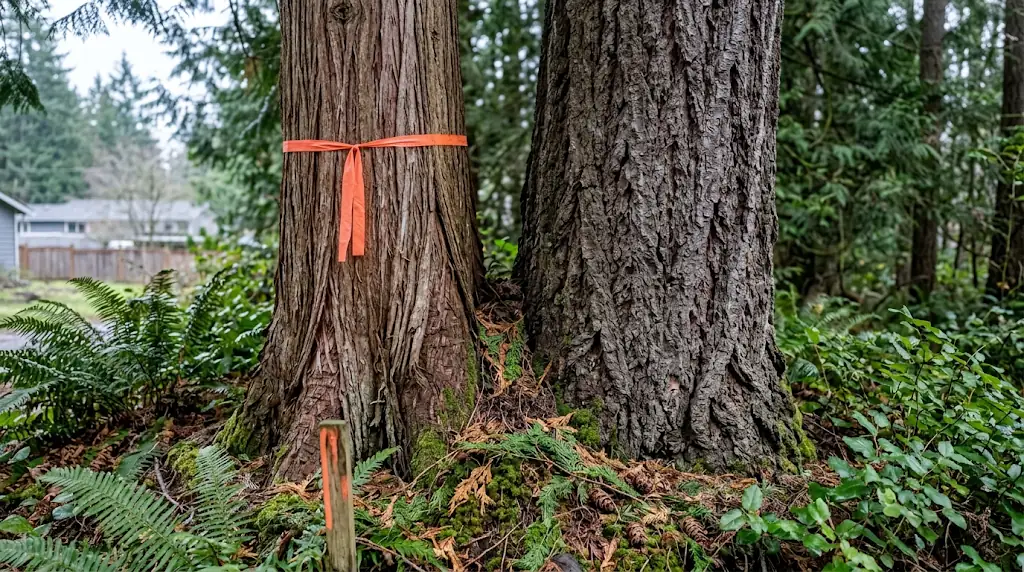
Native Douglas firs and Western red cedars are not protected by species alone on standard private residential property in Auburn, Washington. Homeowners can legally remove up to 6 trees per rolling 12-month period under standard municipal clearing allowances, but strict legal protections apply if the conifer stands in an environmentally critical area, belongs to a mandatory subdivision tree retention plan, sits in the public right-of-way, or falls under commercial land development requirements.
The Species Myth vs. Auburn Municipal Code
Property owners often assume that Washington’s iconic native evergreens—specifically the Douglas fir (Pseudotsuga menziesii) and Western red cedar (Thuja plicata)—are classified as state-protected or endangered species. Under Washington State forestry statutes and Auburn municipal law, this is false.
Neither species carries state or municipal endangered status. On private land, the City of Auburn regulates tree removal based on location, quantity, and site zoning, not biological species.
Under Auburn City Code 15.74.050(A)(4), a private residential lot of one acre or less has a baseline allowance to remove up to 6 trees within any consecutive 12-month period without applying for a permit or undergoing city review. If your mature 90-foot Douglas fir or 70-foot Western red cedar sits in an open backyard outside protected zones, you can remove it legally without municipal paperwork.
4 Scenarios Where Douglas Firs and Cedars Are Legally Protected
While species alone does not grant immunity, mature native conifers frequently trigger legal protections under four municipal and environmental designations:
1. Environmentally Critical Areas (ACC Chapter 16.10)
Douglas firs and Western red cedars play a vital engineering role in South King County: their root systems bind glacial soils and absorb massive volumes of groundwater. Under ACC Chapter 16.10 (Critical Areas), cutting any native tree is prohibited without formal city review in the following zones:
- Erosion & Landslide Hazard Areas: The steep ridges flanking Lea Hill, West Hill, and the valley bluffs rising above the Green River. Removing deep-rooted conifers on slopes exceeding 15% destabilizes the soil mantle, increasing slope failure risks.
- Wetland & Stream Buffers: Riparian zones along the Green River, White River, Mill Creek, and their associated wetland basins. Native conifers regulate water temperatures for migrating salmon and stabilize streambanks.
- Wildlife Habitat Networks: Contiguous native timber corridors designated for wildlife movement.
Removing a conifer inside these zones requires an ISA Certified Arborist evaluation, geotechnical review, and formal Critical Area approval. Unauthorized cutting carries severe fines and mandatory restorative replanting.
2. Subdivision Tree Retention and Landscape Plans
Many master-planned communities built in Auburn across Lea Hill and Lakeland Hills include municipal conditions of approval that mandate tree retention.
- Developers must preserve a specific percentage of “significant trees”—defined in local development standards as healthy evergreen trees with a diameter at breast height (DBH) of 8 to 10 inches or greater.
- If a Douglas fir or Western red cedar was designated as a retained tree on your subdivision’s recorded plat map, it is legally protected.
- Cutting a designated retention tree without an amended landscape plan from City Planning constitutes a municipal code violation, even if it sits entirely on private land.
3. Public Rights-of-Way and Street Frontages
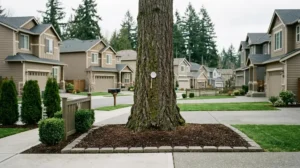
Conifers growing within the strip between the sidewalk and the street curb, or within dedicated municipal easements, fall under Auburn City Code Section 12.36.
- Even if an abutting property owner is responsible for routine pruning to maintain clearance (8 feet over sidewalks, 14 feet over roadways), the tree belongs to the public domain.
- Removing a street-frontage conifer requires an approved Construction Permit issued by the Auburn Public Works Department.
4. Commercial Land Clearing and Plat Development
When a parcel undergoes commercial redevelopment, plat subdivision, or building construction, native conifers lose their standard 6-tree exemption. Auburn development codes enforce specific tree preservation ratios, requiring builders to map all significant trees, fence off tree protection zones (TPZ) at the dripline, and preserve or replace native canopy at strict ratios (often 2:1 or 3:1 native replacement plantings).
Auburn Native Conifer Removal Decision Matrix
| Location & Property Type | Douglas Fir / Cedar Protected? | Governing Code | Required Approvals Prior to Cutting |
| Standard private yard ($\le$ 1 acre), outside critical areas | No (up to 6 per year) | ACC 15.74.050(A)(4) | None. Verify parcel lines and proceed with removal. |
| Steep bluff or slope (>15%) on Lea Hill or West Hill | Yes | ACC Chapter 16.10 | Critical Area Review; geotechnical and TRAQ arborist assessment. |
| Riparian buffer (Green River, White River, Mill Creek) | Yes | ACC Chapter 16.10 | City review; mitigation plan with native replacement stock. |
| Street planting strip / City Right-of-Way | Yes | ACC Chapter 12.36 | City of Auburn Public Works Construction Permit. |
| Designated retention tree on recorded plat map | Yes | ACC 15.74 / Planning Approval | Planning Department modification and replacement plan. |
| Imminent structural hazard in any location | Conditional Exemption | ACC 15.74 / ACC 16.10 | Immediate felling allowed; file arborist report within 10 days. |
Biological Differences: Douglas Fir vs. Western Red Cedar in Auburn
Understanding how these two native giants behave in Western Washington’s climate explains why they often need professional assessment:
Species Profile Comparison:

Douglas Fir (Pseudotsuga menziesii)
├── Root System: Spreading lateral root plate, vulnerable in wet shallow soils
├── Canopy: Dense evergreen sail, high wind resistance
├── Primary Disease: Laminated root rot (Phellinus weirii)
└── Failure Mode: Whole-tree windthrow or lower-trunk snap

Western Red Cedar (Thuja plicata)
├── Root System: Shallow, fibrous, moisture-seeking root network
├── Canopy: Flat, weeping spray foliage; flexible branch architecture
├── Primary Disease: Butt rot, heartwood hollows, top dieback from drought
└── Failure Mode: Co-dominant stem tear-out, hollow trunk collapse
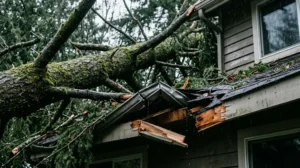
- Douglas Fir Hazards: Douglas firs can reach heights of 100 to 140 feet in South King County residential zones. They have massive, rigid wood structures. Saturated glacial till during Auburn winters reduces the holding power of their shallow lateral root plates. Combined with November windstorms funneling 50+ mph gusts through the Green River Valley, tall firs represent the primary source of residential windthrow damage.
- Western Red Cedar Vulnerabilities: Western red cedars thrive in high-moisture valley floors and natural seeps. Extended summer droughts followed by saturated winter soils stress mature cedars, causing top dieback and central heartwood decay. While cedars flex better in wind than firs, heavy wet snow and freezing rain can snap massive lateral branches or split co-dominant trunks.
Replacing Native Conifers: Auburn Mitigation Rules
When native conifers are removed under a required municipal permit (such as inside a critical area buffer or during development), the city generally mandates replacement with approved native species rather than ornamental landscape varieties.
- Approved Native Replacements: The City of Auburn favors native Pacific Northwest stock, including Western hemlock (Tsuga heterophylla), grand fir (Abies grandis), big-leaf maple (Acer macrophyllum), or replacement Western red cedars.
- Sizing Standards: Replacement conifers must typically meet minimum stock standards (such as 5- to 6-foot balled-and-burlapped or container-grown trees) to ensure high establishment survival rates.
- Monitoring: Commercial and critical-area permits often require a 3- to 5-year monitoring period to verify that replacement conifers successfully establish root systems.
5-Step Verification Checklist Before Removing an Auburn Conifer
- [ ] Verify Property Lines: Locate physical survey pins to confirm the trunk is entirely on your deeded land, not straddling a boundary line or sitting in city right-of-way.
- [ ] Inspect Critical Area Overlays: Check the City of Auburn GIS parcel map to confirm your lot does not fall under steep slope, erosion, or stream buffer overlays.
- [ ] Review Original Plat Restrictions: Check your title paperwork or HOA covenants for tree preservation tracts, open space easements, or architectural review board rules.
- [ ] Examine Trunk and Root Flare Health: Check for fungal conks (Phellinus weirii), sawdust from bark beetles, cavities, or tension cracks along the base.
- [ ] Hire a Licensed Contractor: Verify that any tree removal company holds an active license, bonded status, and active workers’ compensation via the Washington State L&I Verification Portal.
Evaluating mature native conifers requires experienced rigging, heavy equipment, and precise knowledge of local critical area codes. [demo_data field=business_name] delivers ISA-certified health assessments, tight-quarter technical removals, and full municipal permit assistance across Auburn. Visit our contact page to book an on-site evaluation for your Douglas firs or Western red cedars.