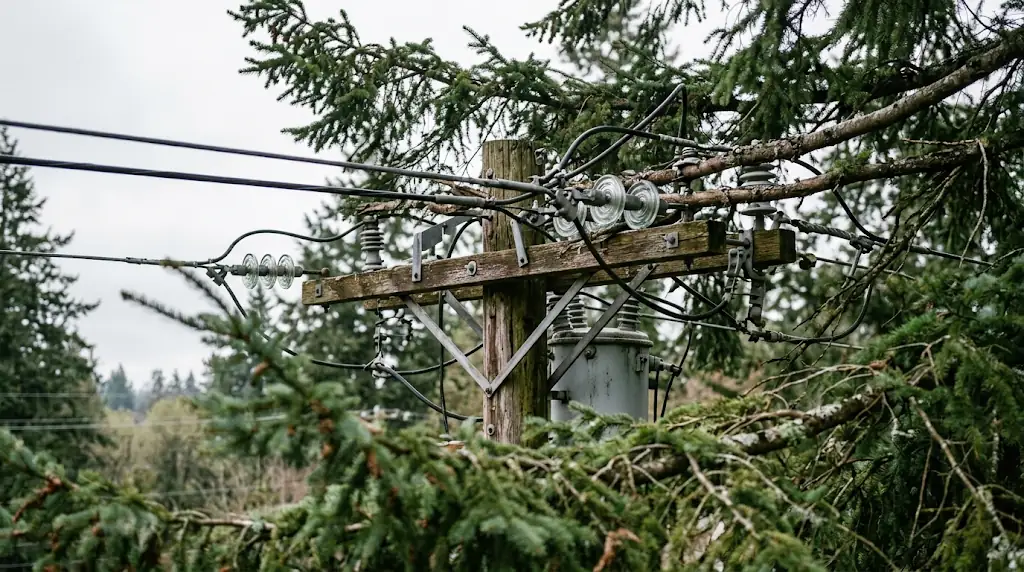
Puget Sound Energy (PSE) will trim or remove trees for free only if branches or trunks directly threaten high-voltage primary distribution or transmission lines running from pole to pole. Neither PSE nor the City of Auburn will remove or prune trees near private service drops—the low-voltage lines running from the utility pole to your home—leaving that work entirely to the private property owner.
Primary Lines vs. Service Drops: The Critical Electrical Distinction
Free tree management depends entirely on the electrical classification of the wire. Utility systems in Auburn divide overhead lines into two distinct categories:
| Wire Classification | Line Ownership & Voltage | Free Removal or Pruning? | Responsible Party | Required Action |
| Primary Distribution Lines | PSE owned (7,200V to 34,500V); runs pole-to-pole along streets and easements | Yes (Free) | Puget Sound Energy (Vegetation Management) | Call PSE at 1-888-225-5773 to request an arborist inspection. |
| Transmission Lines | PSE owned (55,000V to 230,000V+); high-tower cross-county corridors | Yes (Free) | Puget Sound Energy | Monitored directly under federal reliability standards. |
| Secondary Service Drops | Joint ownership; low-voltage (120V/240V) line running from pole to house weatherhead | No (Homeowner pays) | Private Property Owner | Hire an ISA Certified Arborist; request a free PSE safety disconnect. |
| City Right-of-Way Street Trees | City of Auburn public street frontage (interfering with road/sidewalk clearance) | Conditional (Non-electrical only) | Adjacent Property Owner / City Public Works | City handles traffic hazards; property owners trim to code under ACC 12.36. |
| Telecommunications Lines | CenturyLink, Comcast, or wave broadband lines running below power lines | No | Telecom Provider / Property Owner | Low-voltage; telecom carriers rarely prune trees unless cables sever. |
When Puget Sound Energy Trims or Removes Trees for Free
PSE manages thousands of line miles across Western Washington and schedules regular trimming cycles through South King County. PSE will send a crew to prune or cut down a tree at zero out-of-pocket cost under specific operating conditions outlined in the PSE Tree Trimming Program:
- Pole-to-Pole Encroachment: Any branch growing within, over, or under the high-voltage wires running along roads, alleys, or dedicated utility easements.
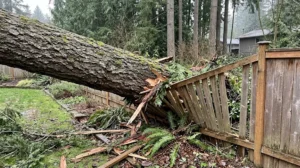
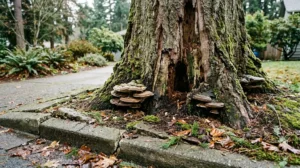
- Structurally Hazardous Trees Outside the Right-of-Way: If a large Douglas fir, Western red cedar, or big-leaf maple stands on private property but exhibits severe lean, fungal conks, or root rot that could crush a primary line upon failure, PSE will dispatch an arborist. If the arborist deems the tree an imminent hazard to the electrical grid, PSE will fell the tree to ground level for free.
- Wood Cleanup Limits: While PSE cuts down hazardous trees near primary lines for free, their crews generally chip smaller brush but leave trunk wood and large logs on-site. The fallen timber remains property of the landowner to dispose of or process for firewood.
Property owners can request a free utility hazard inspection by contacting PSE Customer Service at 1-888-225-5773 or filing a request through the PSE Tree Trimming Contact Portal.
When Tree Work Near Power Lines Is Your Financial Responsibility
Many homeowners assume that because power lines connect to their house, the utility company must maintain the trees around them. This is legally incorrect.
The Service Drop Exception
The overhead insulated line that spans from the utility pole in the street to the masthead or meter base on your home is called the service drop. PSE does not prune or remove trees touching or threatening service drops.
Maintaining branch clearance along the service drop is 100% the homeowner’s financial duty:
- If an overgrown birch or Douglas fir drops a limb on the service drop, the homeowner pays for the private tree service to clear it.
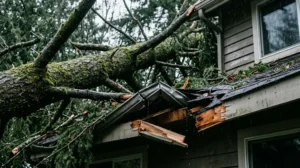
- If a falling tree tears the weatherhead or electrical panel off your house, PSE will reconnect the wire to the mast once repaired, but the homeowner pays for the private electrician, city electrical permits, and private tree removal.
Free Temporary Service Disconnections
Never attempt to trim or cut trees touching a service drop yourself. Even insulated lines carry lethal 120V/240V currents if protective jackets wear thin from branch friction.
To ensure safety, PSE provides a free preventative service:
- Schedule a private tree removal contractor.
- Call PSE at 1-888-321-7779 at least five business days before tree work begins.
- PSE sends a utility technician to temporarily disconnect the service drop from the pole or meter base on the morning of the job.
- Your private tree care crew safely cuts the branches or drops the tree with zero electrocution hazard.
- PSE reconnects and re-energizes the service line once the crew completes work.
Does the City of Auburn Remove Trees Near Power Lines?
No. The City of Auburn does not trim, maintain, or remove trees around electrical power lines.
The City of Auburn is a municipal government entity, not an electric utility. Puget Sound Energy owns and operates the electrical distribution grid within Auburn city limits. Auburn Public Works operates under clear municipal boundaries:
- Public Works Jurisdiction: Auburn handles street pavement, stormwater systems, traffic signals, and municipal parks. Under Auburn City Code Section 12.36, the city enforces clearance over sidewalks (8 vertical feet) and public roadways (14 vertical feet).
- Adjacent Property Owner Obligations: Even for trees planted in the planting strip between the sidewalk and the street curb, Auburn code designates maintenance as the responsibility of the abutting real property owner.
- Electrical Safety Conflicts: If a city-owned street tree touches a high-voltage power line, Auburn Public Works does not touch it; they place an emergency service order directly to Puget Sound Energy.
High Winds, Saturated Soils, and Auburn Power Outages
Auburn experiences regional storm patterns that make trees near power lines unusually dangerous:
- The Green River Valley Wind Funnel: Fall and winter cold fronts push severe winds through the Green River gap, generating sustained gusts of 45 to 60 mph across Auburn, Algona, and Pacific.
- Glacial Soil Saturation: Auburn averages over 40 inches of annual precipitation. Soil saturation between November and February softens the root plates of tall conifers located along the bluffs of Lea Hill and West Hill.
- Brittle Native Species: Big-leaf maples (Acer macrophyllum) and red alders (Alnus rubra) are prone to heart rot and co-dominant stem failure. During early fall storms when deciduous trees still hold wet foliage, canopy weight splits massive limbs straight onto overhead wires.
Action Plan: 5 Steps to Address Trees Threatening Power Lines in Auburn
- [ ] Identify the Line Type: Stand at a safe distance and trace the wires. If the wire runs from pole to pole down the road, it is a primary line. If it runs from a single pole directly into a home’s roof mast, it is a service drop.
- [ ] Assess Physical Contact: If tree branches are smoking, sparking, or actively arcing against wires, clear the area immediately and call 911 and PSE Emergency Services at 1-888-225-5773.
- [ ] Submit a PSE Assessment Request: For non-emergency contact with primary distribution lines, submit a service inquiry through PSE’s vegetation management division. Allow two to four weeks for field evaluation.
- [ ] Coordinate Private Tree Crews for Service Drops: If the tree threatens your personal line, obtain quotes from an ISA Certified Arborist with line-clearance qualifications.
- [ ] Verify Contractor Licensing: Ensure any tree service working within 10 feet of utility infrastructure carries an active license and commercial liability coverage verified through the Washington State Department of Labor & Industries.
Removing trees tangled in overhead service lines requires heavy technical rigging, specialized aerial gear, and direct coordination with utility dispatchers. Auburn Tree Removal handles complex power-line clearance trimming, hazardous conifer removals, and PSE-coordinated shutdowns throughout Auburn. Reach out via our contact page to arrange an on-site evaluation with an experienced tree specialist.