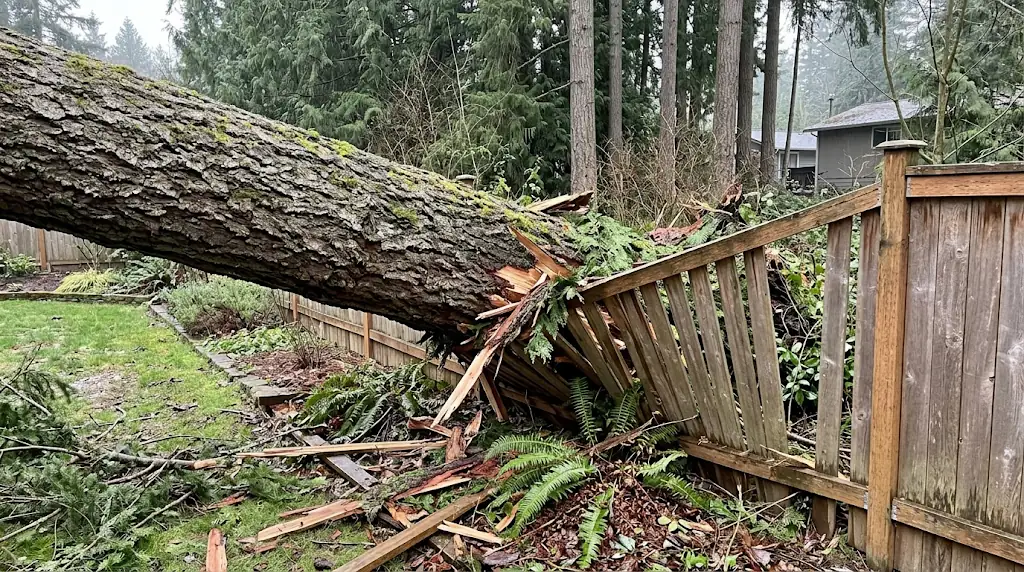
Under Washington State law, your own homeowners insurance policy pays for damage and cleanup if a neighbor’s healthy tree falls onto your property due to wind, saturated soil, or natural forces. Your neighbor is legally and financially liable only if you prove they were negligent—meaning the tree was visibly dead, diseased, or hazardous, and they failed to address the documented risk before it fell.
Washington State Law: The “Act of God” Rule vs. Landowner Negligence
Liability in Washington hinges entirely on tree health prior to the collapse. Washington tort law separates falling tree incidents into two legal categories:
1. Natural Events (“Acts of God”)
When severe weather causes a structurally sound tree to uproot or snap, the law treats the incident as an Act of God. Neither homeowner is legally at fault. Under guidance from the Washington State Office of the Insurance Commissioner, the location where the tree lands dictates financial responsibility:
- Your homeowners insurance policy pays for the repairs to your roof, siding, fence, or outbuildings, minus your deductible.
- Your neighbor is not legally obligated to pay your insurance deductible, clean up branches on your side of the boundary line, or reimburse your out-of-pocket expenses.
2. Landowner Negligence and Premises Liability
A tree owner is liable for third-party property damage only when a claimant proves four legal elements:
- Duty: The owner had a legal duty to maintain their real property safely.
- Breach: The owner knew, or reasonably should have known, that the tree posed an active structural hazard.
- Causation: The owner’s failure to remove or mitigate the hazard caused the failure.
- Damages: The structural failure resulted in quantifiable property destruction.
If your neighbor ignored visible signs of rot, fungal conks, severe lean, or root death—particularly after receiving written notice—their homeowner liability insurance must cover your structural losses and cleanup expenses.
Auburn Tree Fall Liability and Insurance Matrix
| Incident Scenario | Primary Paying Party | Insurance Policy Type | Deductible Responsibility |
| Healthy tree falls on your house/garage during a storm | Your insurance company | Your Homeowners Insurance (Dwelling Coverage) | You pay your standard policy deductible. |
| Documented dead/hazardous tree crushes your roof | Neighbor’s insurance carrier (via subrogation) | Neighbor’s Homeowner Liability Coverage | Your insurer pays initially, then reclaims your deductible from the neighbor. |
| Neighbor’s tree falls into your yard (no structural damage) | You (out-of-pocket) | Typically not covered by standard insurance | No insurance payout; insurers generally exclude debris removal unless a structure is struck. |
| Neighbor’s tree crushes your car in your driveway | Your auto insurer | Your Auto Insurance (Comprehensive Coverage) | You pay your comprehensive auto deductible, not your home deductible. |
| Tree falls across the boundary line, resting on both yards | Split at the property line | Respective homeowner policies | Each neighbor pays to remove timber resting on their side of the lot line. |
| City-owned street tree falls on your house | City of Auburn or your insurer | Municipal Risk Pool or your Homeowners Policy | City pays only if formal notice of municipal tree defect was filed prior to collapse. |
Property Line Cleanup: Who Owns the Fallen Wood?
When a tree crosses a property boundary, responsibility splits exactly at the property line:
- Debris on Your Side: You are responsible for cutting and removing all timber, limbs, and brush located within your property boundaries.
- Debris on the Neighbor’s Side: The neighbor is responsible for cutting and hauling away the portion of the trunk remaining on their property.
- Timber Ownership Rights: While you must clear your yard, Washington law establishes that the wood technically belongs to the owner of the property where the tree was rooted. You cannot sell the timber or convert high-value logs without offering the wood back to the neighbor. If they decline, you may dispose of it.
Overhanging Limbs: The Washington Self-Help Rule and Timber Trespass
You do not have to wait for a storm to address a neighbor’s encroaching tree. Washington common law provides adjoining property owners with the right of “self-help.”
Your Legal Rights to Trim
Under Washington case law, you may trim encroaching branches and subterranean roots back to your property boundary line at your own expense. You do not need the neighbor’s permission to cut limbs hanging over your air space, provided:
- You stay strictly on your side of the property line.
- You do not enter the neighbor’s property without explicit written consent.
- Your pruning does not compromise the structural stability or health of the tree.
Severe Penalties: Timber Trespass (RCW 64.12.030)
Exercise caution when cutting overhanging branches. Under RCW 64.12.030, Washington imposes strict liability and treble damages (triple the replacement value of the tree) on anyone who cuts down, girdles, or damages someone else’s timber without lawful authority. If your aggressive pruning kills the neighbor’s mature Western red cedar or causes it to become unstable, you are liable for triple the tree’s landscape appraisal value, plus surveyor fees and attorney expenses.
Establishing Negligence: The “Notice of Hazard” Protocol
South King and Pierce counties experience heavy rainfall saturating glacially deposited soils between October and April. Sustained winds through the Green River Valley frequently trigger windthrow in compromised conifers. If you identify a hazardous tree on an adjacent lot, establish legal notice before winter storms arrive:
- Hire an ISA Certified Arborist: Request a formal Tree Risk Assessment Qualification (TRAQ) report. The arborist must identify specific structural defects, including root plate decay (Phellinus weirii), trunk cavities, dead topwood, or severe lean angles.
- Draft a Formal Written Notice: Write a concise letter identifying the tree, citing the arborist’s findings, and requesting immediate mitigation.
- Send via Certified Mail: Send the notice via USPS Certified Mail with Return Receipt Requested. Retain a digital copy and the signed delivery confirmation.
- Notify City Code Compliance: If the property owner refuses to act and the tree threatens public infrastructure or adjacent residential dwellings, submit a complaint under Auburn City Code to the Auburn Code Compliance Division.
This certified paper trail strips the neighbor of the “Act of God” legal defense. If the tree collapses in a subsequent storm, your insurance company’s subrogation division will use this documentation to force the neighbor’s carrier to pay all structural repairs and reimburse your deductible.
Immediate Checklist When a Neighbor’s Tree Falls on Your Auburn Property
- [ ] Ensure Physical Safety: Evacuate rooms beneath impacted roof trusses. Watch for hanging overhead branches (“widow-makers”).
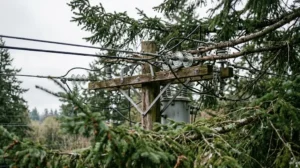
- [ ] Inspect Electrical Lines: If branches contact overhead service drops or street lines, maintain a 35-foot perimeter and report the hazard immediately to Puget Sound Energy at 1-888-225-5773.
- [ ] Capture Time-Stamped Visual Evidence: Take wide-angle and close-up photographs of the fallen tree, point of failure (uprooted plate or trunk fracture), structural damage, and the boundary line before touching any debris.
- [ ] Mitigate Secondary Losses: Install emergency poly-tarps over roof punctures to prevent interior rain damage. Standard insurance policies require homeowners to take reasonable steps to prevent ongoing weather intrusion.
- [ ] File a Claim with Your Own Insurer: Provide your agent with photos, policy details, and any previous written notices served to the neighbor.
- [ ] Hire a Registered Tree Service: Select a tree contractor with active Washington State Department of Labor & Industries registration and comprehensive commercial liability insurance.
Navigating boundary-line tree hazards requires precision, proper rigging equipment, and clear documentation. Auburn Tree Removal handles complex storm damage mitigation, crane-assisted extractions, and certified hazard evaluations across Auburn. Reach out through our contact page to arrange an urgent hazard assessment or schedule a site inspection.