Professional tree removal in Auburn, Washington, typically costs between $450 and $2,200 for standard residential trees, with an average baseline cost of $950 per tree. High-risk removals involving mature Douglas firs or Western red cedars exceeding 80 feet, steep slope rigging, or crane access near structures and utility lines range from $2,500 to $6,500 or more.
Auburn Tree Removal Cost by Size and Species
Tree height, trunk diameter at breast height (DBH), and wood density dictate the equipment, labor hours, and risk profile required for removal.
| Tree Category | Height Bracket | Average Price Range | Typical Auburn Species | Required Crew & Equipment |
| Small | Under 25 feet | $350 – $650 | Japanese maple, flowering dogwood, fruit trees | 2-person crew, ground rigging, standard chipper |
| Medium | 25 – 50 feet | $650 – $1,400 | Red alder, paper birch, vine maple, small hemlock | 2 to 3-person crew, aerial lift or manual climbing spikes |
| Large | 50 – 80 feet | $1,400 – $2,800 | Big-leaf maple, Western hemlock, medium Douglas fir | 3 to 4-person crew, friction lowering brakes, heavy rigging |
| Very Large / Conifer | 80 – 120+ feet | $2,800 – $5,500 | Old-growth Douglas fir, Western red cedar, cottonwood | 4+ person crew, advanced technical rigging, log loaders |
| Severe Hazard / Crane | Any height | $3,500 – $7,000+ | Compromised trees on steep bluffs, leaning over roofs | Mobile crane operator, bucket truck, TRAQ-certified lead |
The Primary Factors Dictating Tree Removal Pricing in Auburn
Flat pricing does not exist in arboriculture. Site-specific physical variables establish the final estimate on every Auburn parcel:
1. Proximity to Structures and Drop Zones
A 90-foot Douglas fir in an open field on an acre parcel in the Green River Valley can be straight-felled at the base in under an hour, costing closer to $1,200. That exact same tree positioned five feet between a home foundation and a backyard fence on Lea Hill requires piecemeal sectioning. Crews must climb the tree, limb each branch individually, and rope-lower every log using friction brakes to prevent roof, gutter, and lawn impact. That shifts the price past $3,000.
2. Terrain and Slope Gradients
Auburn’s geography transitions sharply from flat river basins up to steep residential ridges along Lea Hill and West Hill. Trees located on slopes exceeding 15% restrict heavy equipment access:
- Chippers and bucket trucks cannot drive directly to the trunk.
- Crews must manually carry heavy rounds uphill or rig high-line rope trolleys to pull timber to the street.
- Increased physical labor and rope friction wear add 20% to 40% to overall project labor costs.
3. Power Line Conflicts and Utility Clearances
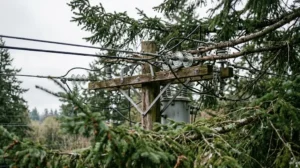
Trees growing into high-voltage electrical distribution lines require strict clearance protocols. Puget Sound Energy (PSE) maintains right-of-way clearance around main transmission infrastructure, but service drops running from the street transformer to an Auburn home remain the homeowner’s responsibility. Working within 10 feet of live electrical conductors requires certified line-clearance tree trimmers, slowing operations and increasing insurance exposure.
4. Regional Wood Disposal and Hauling Logistics
Weight directly dictates disposal expense. Dense native timber such as Pacific madrone and water-logged big-leaf maple weighs substantially more than softwoods. In South King County, clean wood and organic yard waste disposal fees at regional facilities, including the South County Recycling and Transfer Station in Algona, carry set commercial per-ton and minimum vehicle rates. A mature 100-foot conifer produces 4 to 8 tons of wood and brush. Hauling that volume off-site adds significant equipment transit and gate fees to a contractor’s baseline operating cost.
Add-On Services: Itemized Cost Breakdown
Standard tree removal estimates cover cutting the tree to a ground-level stump. Additional processing, below-ground removal, and administrative tasks carry separate line items.
| Service Add-On | Pricing Range | Operational Scope |
| Stump Grinding | $150 – $450 (standard) / $500 – $900 (large root flare) | Grinding 6 to 12 inches below grade; lateral surface root tracking |
| Wood Chipping & Debris Haul | $200 – $600 per load | Chipping branch canopies and vacuuming chips off lawn surfaces |
| Log Splitting & Firewood Stacking | $150 – $350 | Cutting trunk wood into 16-inch fireplace rounds left on-site |
| Crane Service Rental | $1,200 – $2,500 daily minimum | 40- to 60-ton hydraulic crane with certified operator for zero-impact lifts |
| TRAQ Arborist Assessment Report | $250 – $600 | Written Tree Risk Assessment Qualification report for city permit documentation |
Emergency Removals vs. Scheduled Maintenance
Pacific Northwest winters bring high-moisture weather patterns from October through March. Continuous heavy rainfall saturates Auburn’s sandy-loam soils, weakening root plates right before windstorms sweep through Puget Sound with gusts reaching 45 to 60 mph.
Emergency tree removals triggered by storm failures carry higher costs than scheduled maintenance:
- Immediate Response Surge: Mobilizing a crew during active windstorms, after normal working hours, or on holidays carries overtime labor rates, typically running 50% to 100% higher than standard scheduled bids ($250 to $450 per crew hour).
- Structural Compromise: Uprooted trees lodged against a roof or resting on a service wire cannot be rigged normally. They require crane stabilization to prevent secondary structural collapse, driving total bills to $4,000–$8,000+.
- Homeowners Insurance Coverage: If a tree falls onto an insured structure (home, detached garage, workshop), homeowners insurance policies generally cover emergency mitigation and removal up to specified policy limits. If a healthy tree falls harmlessly in an open lawn, policies rarely cover removal costs.
Municipal Permit Expenses in Auburn
Before hiring a contractor, confirm whether your tree requires city paperwork under the clearing rules defined in the municipal code:
- Standard Removal (Under 6 trees per acre): No municipal permit fee. Under Auburn Tree Maintenance and Removal guidelines, single-family residential parcels up to one acre can remove up to 6 trees per rolling 12 months without city fees.
- Critical Area Clearing: If your property borders a designated wetland buffer, stream corridor, or steep geologic hazard zone, Auburn requires a Critical Area Review. Arborist assessments, plan reviews, and city administrative filings add $500 to $1,500+ in soft costs before cutting begins.
5-Point Quote Verification Checklist for Auburn Homeowners
Never accept an oral estimate from an unverified door-to-door solicitor. Before signing an agreement or paying a deposit, execute this verification process:
- [ ] Verify L&I Contractor Registration: Search the company on the Washington State Department of Labor & Industries Verification Tool. Confirm an active contractor license, active workers’ compensation coverage, and an unexpired surety bond.
- [ ] Demand a Certificate of Liability Insurance: Request an insurance certificate sent directly from the broker naming you as a certificate holder, showing at least $1,000,000 to $2,000,000 in general liability. Tree removal poses catastrophic property risks.
- [ ] Confirm ISA Arborist Credentials: For hazard assessments, heritage trees, or critical area filings, require an ISA (International Society of Arboriculture) Certified Arborist with TRAQ credentials.
- [ ] Examine the Scope of Cleanup: Check the contract language for debris handling. Bids should explicitly state whether wood chips are hauled away, logs are cut to firewood length, or timber is taken off-site.
- [ ] Require Written Stump Grinding Depth: Verify whether stump removal includes only the central collar or all surface root flares, and confirm whether backfilling the resulting depression with mulch or topsoil is included.
Clear tree removal estimates depend entirely on an in-person structural evaluation of your trees, terrain, and drop zones. Auburn Tree Removal delivers transparent, fully itemized quotes backed by complete licensing, industrial-grade rigging equipment, and experienced local arborists. Reach out through our contact page to schedule a detailed on-site assessment for your Auburn property.