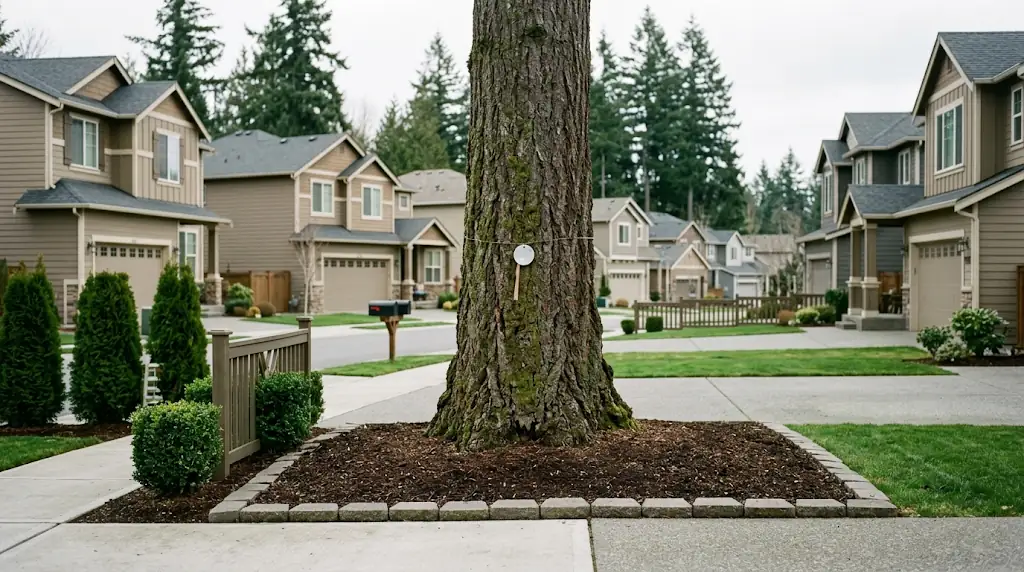
Yes, a Homeowners Association (HOA) can legally stop you from cutting down a tree on your private property if your community’s recorded Covenants, Conditions, and Restrictions (CC&Rs) mandate prior architectural approval or canopy retention. While City of Auburn municipal regulations allow property owners to remove up to 6 trees per rolling 12 months without a city permit, municipal clearing allowances do not override private deed restrictions or HOA board authority under Washington State law.
City Law vs. HOA Authority: The Legal Hierarchy
A common misconception among Auburn homeowners is that municipal code supersedes neighborhood rules. In Washington State, municipal zoning law and private real estate covenants operate under separate legal jurisdictions:
- City of Auburn Jurisdiction: Under Auburn City Code 15.74.050(A)(4), property owners on parcels up to one acre can remove up to 6 trees per rolling 12-month period without a city permit, provided the parcel is not in a critical area or public right-of-way. The city enforces municipal safety and grading standards; it does not enforce private neighborhood contracts.
- HOA Jurisdiction: HOAs in Washington are governed by Chapter 64.38 RCW (Homeowners’ Associations) and Chapter 64.90 RCW (the Washington Uniform Common Interest Ownership Act). When you purchase a home within an HOA development, the recorded CC&Rs run with the land as a binding contract. If those covenants restrict tree cutting, the HOA board has full legal authority to deny your removal request, regardless of city permit exemptions.
Auburn HOA Tree Removal Decision Matrix
| Tree & Property Scenario | City Permit Needed? | HOA Approval Needed? | Primary Governing Authority | Outcome If Cut Without Approval |
| Healthy tree on private lot in an Auburn HOA | No (if $\le$ 6 trees/yr) | Yes | HOA CC&Rs / Architectural Review Committee (ARC) | Association fines, demand for mature tree replacement, legal injunction. |
| Tree planted as part of original master plat approval | Yes (Planning check) | Yes | Auburn City Code Chapter 15.74 & HOA CC&Rs | Municipal code violation notice plus HOA contractual fines. |
| Documented structural hazard tree (TRAQ certified) | No (standard lots) | Notification only | Washington Premises Liability Law & ISA TRAQ Standards | Emergency hazard removal permitted; replacement tree may be required. |
| Tree located in HOA Common Area / Greenbelt | No (unless Critical Area) | Strictly Prohibited | HOA Board Ownership (RCW 64.90.440) | Timber trespass liability (RCW 64.12.030) carrying treble (3x) damages. |
| Overhanging branches from HOA common area into private yard | No | Self-Help Pruning | Washington Common Law (Right to Prune to Lot Line) | Allowed to prune to boundary line; cannot enter HOA property or kill the tree. |
Architectural Review Committees (ARC) in Auburn Neighborhoods
Auburn contains numerous planned communities—such as Lakeland Hills, Lea Hill master developments, and The Bridges—governed by active HOAs with dedicated Architectural Review Committees (ARC) or Architectural Control Committees (ACC).
These committees restrict tree removal based on specific community standards:
- Canopy Preservation Standards: Many subdivisions maintain strict minimum canopy metrics to preserve uniform neighborhood aesthetics and property values. Covenants often require a minimum of one or two mature shade trees in front yard setbacks.
- Species and Caliper Guidelines: HOAs frequently designate lists of protected ornamental and native species, restricting removals of mature red oaks, Western red cedars, and flowering dogwoods while requiring replacements to meet minimum trunk caliper thresholds (typically 2 to 3 inches at installation).
- View Covenants vs. Tree Retention: In elevated Auburn neighborhoods like Lakeland Hills and Lea Hill, disputes frequently arise between homeowners seeking to clear trees for Mt. Rainier or Green River Valley views and adjacent owners protected by tree retention clauses. Unless an HOA’s CC&Rs contain an explicit view preservation easement, tree retention clauses almost universally take legal precedence over view improvements.
The Legal Exception: Imminent Structural Hazards
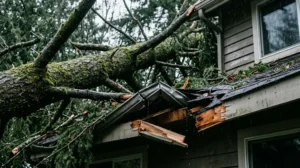
An HOA’s authority is not unlimited. An association cannot legally compel a homeowner to maintain an imminent safety hazard that threatens life or residential dwellings.
The Liability Trap for HOA Boards
Under Washington premises liability principles, once a tree owner has documented knowledge that a tree is structurally compromised, failing to mitigate the defect constitutes negligence. If an HOA board arbitrarily denies a homeowner’s request to remove a verifiably dangerous conifer, the board exposes the association to third-party liability if the tree subsequently collapses during a Puget Sound windstorm.
How to Bypass an HOA Denial for a Dangerous Tree
To legally override or expedite an HOA denial, follow this formal procedure:
- Commission an ISA Certified Arborist Report: Hire an International Society of Arboriculture (ISA) arborist holding the Tree Risk Assessment Qualification (TRAQ).
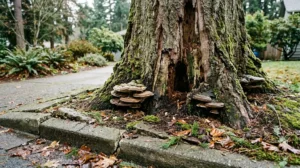
- Obtain an ISA Form Evaluation: The arborist must fill out a formal ISA Basic Tree Risk Assessment Form classifying the hazard rating as “High” or “Extreme” and detailing specific defects (e.g., Phellinus weirii root rot, basal hollows, ground-plate heaving, or severe co-dominant trunk fractures).
- Submit Formal Notice via Certified Mail: Deliver the arborist report along with an expedited removal request to the HOA board and management company. Specify that delaying removal creates active premises liability and structural risk.
- Offer a Replanting Concession: Address aesthetic concerns proactively by agreeing to plant an approved replacement tree once the hazardous timber is safely felled.
What Happens If You Cut Down a Tree Without HOA Approval?
Cutting down a tree without prior ARC approval in an Auburn community triggers severe financial and legal penalties:
- Fines and Enforcement Actions: Under RCW 64.38.020 and RCW 64.90.405, HOAs have statutory authority to levy substantial fines for covenant violations. Daily or per-incident fines frequently escalate into thousands of dollars.
- Mandatory Mature Tree Replacement: HOA boards routinely require homeowners to plant replacement trees of equivalent landscape value. Installing mature, containerized 15- to 20-foot trees via spade trucks can cost $2,000 to $5,000 per tree.
- Statutory Property Liens: If an owner refuses to pay fines or replanting fees, the association can record a lien against the real property, clouding title and preventing refinancing or sale until fully satisfied.
- Timber Trespass (Cutting in Common Areas): Cutting or trimming trees in an HOA greenbelt or common open space tract without board authorization triggers Washington’s Timber Trespass statute (RCW 64.12.030). The court mandates treble (3x) damages based on the replacement cost of the timber, plus surveyor and legal fees.
5-Step Action Checklist for Auburn HOA Homeowners
Before scheduling a tree service, execute this five-step compliance checklist:
- [ ] Locate and Review Your CC&Rs: Read the landscape and architectural review sections of your association documents to identify approval timelines, submission requirements, and fine schedules.
- [ ] Verify Property Lines: Confirm via your parcel survey that the tree trunk originates entirely on your private lot and does not cross into an HOA common maintenance tract.
- [ ] Commission an ISA TRAQ Report: If the removal is driven by structural safety concerns, obtain a certified hazard evaluation to substantiate your ARC application.
- [ ] Submit an Architectural Request Form: File the complete application—including the arborist report, site photos, contractor credentials, and replacement tree selections—and retain proof of delivery.
- [ ] Verify Contractor Licensing: Ensure your tree contractor maintains active licensing and commercial general liability insurance verified through the Washington State L&I Verification Portal.
Navigating HOA architectural requirements while managing dangerous trees requires technical documentation, certified arborist reporting, and precision rigging. Auburn Tree Removal assists homeowners across Auburn with comprehensive hazard assessments, ARC-ready arborist reports, and zero-impact tree removals. Reach out through our contact page to schedule a consultation with an experienced local tree specialist.