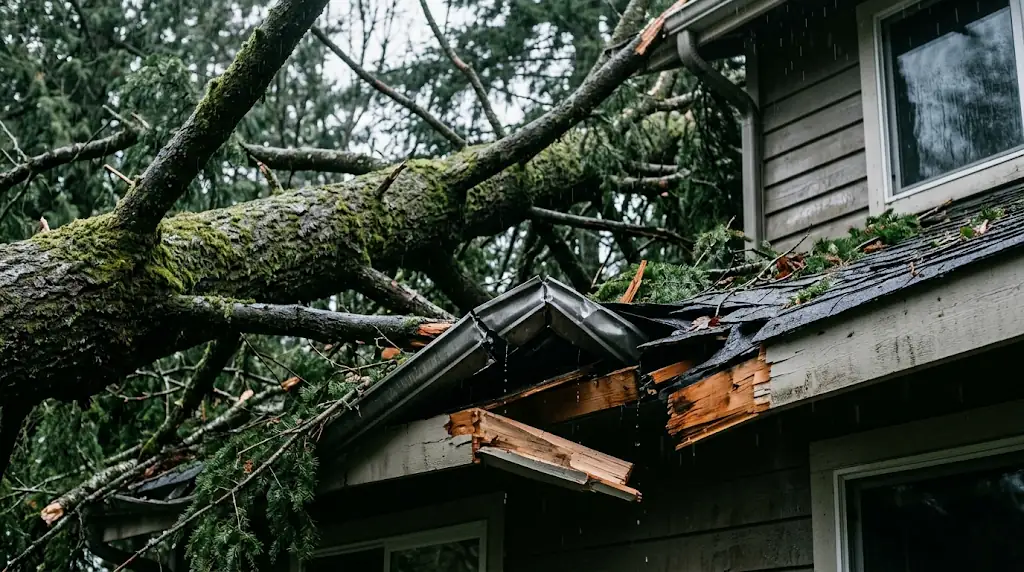
Evacuate everyone from the impact zone immediately, check for injuries, and call 911 if there is structural collapse or downed utility lines. Once everyone is safe outside the strike path, shut off utilities if accessible without entering damaged rooms, document the damage with date-stamped photos, notify your insurance carrier, and dispatch an emergency tree removal service equipped for crane-assisted extractions.
The Immediate 6-Step Triage Protocol
A multi-ton conifer crushing a roof structure creates extreme physical tension, fire hazards, and secondary collapse risks. Execute these six steps in order:
Step 1: Evacuate the Impact Zone
Step 2: Check for Electrical, Gas, and Water Hazards
Step 3: Alert First Responders and Puget Sound Energy
Step 4: Contact Your Insurance Provider
Step 5: Document the Scene Completely
Step 6: Deploy a Crane-Equipped Emergency Tree Crew
Step 1: Evacuate the Impact Zone and Account for Occupants
Do not stay inside rooms beneath the impact area. A mature Douglas fir can weigh between 10,000 and 30,000 pounds; compromised ceiling joists and roof trusses can give way minutes or hours after initial impact.
- Move all family members and pets to an unaffected portion of the home or outside to a safe vehicle.
- If the tree penetrated the living space or cracked structural load-bearing walls, exit the building entirely.
- Stay clear of exterior walls directly beneath the fallen trunk.
Step 2: Assess Electrical, Gas, and Water Hazards
Falling timber frequently tears down service drops, punctures plumbing pipes, and crushes gas meters.
- Electrical: If wires are severed or sparks appear, do not touch wet drywall, metal fixtures, or standing water. If your main electrical breaker panel is located in an unaffected area, flip the master breaker to cut power to the home.
- Natural Gas: If you smell sulfur or hear hissing near damaged walls, evacuate the property immediately. Do not flip light switches or ignite flames.
- Plumbing: If the tree ruptured overhead plumbing or fire sprinkler lines, locate the primary water shut-off valve near your water meter or crawlspace and turn it clockwise 90 degrees to shut off the main supply.
Step 3: Alert First Responders and Puget Sound Energy
Emergency situations require specific municipal and utility notifications:
- Life Safety Emergencies (911): Call 911 immediately if someone is trapped, you smell natural gas, or structural collapse threatens life safety. The Valley Regional Fire Authority serves Auburn, Algona, and Pacific and handles technical rescues and building stabilization.
- Downed Electrical Lines: If power lines are down or touching the fallen tree, treat them as energized and lethal. Keep a minimum perimeter of 35 feet away. Report downed lines immediately to Puget Sound Energy Outage Services or call 1-888-225-5773.
Step 4: Contact Your Homeowners Insurance Carrier
Call your insurance company’s 24/7 claims hotline as soon as physical safety is secured.
- Open a formal claim and secure your claim number.
- Confirm your policy’s emergency mitigation limits. Under standard Washington homeowners policies, insurers require policyholders to take reasonable steps to prevent further damage (such as emergency tarping).
- Ask whether your policy includes immediate coverage for emergency tree extraction and crane services, or if they require an insurance adjuster on-site prior to timber removal. Most policies authorize immediate extraction if the tree is actively crushing the dwelling.
Step 5: Document the Scene Completely Before Disturbance
Before any tree service cuts a single branch, gather clear photographic and video evidence for your insurance adjuster:
- Take wide-angle exterior photos showing the entire fallen tree, the root base, and its position on your home.
- Photograph the failure point (e.g., uprooted root plate, snapped trunk, or decayed crotch).
- Capture detailed interior photos of roof punctures, cracked ceilings, collapsed drywall, water intrusion, and broken windows.
- Photograph any property lines if the tree originated from a neighboring parcel to assist with insurer subrogation.
Step 6: Deploy an Emergency Tree Service
Never attempt to cut a fallen tree off a house with a consumer chainsaw. A tree resting on a building is under severe mechanical load, rotational tension, and compression. Cutting the wrong branch can cause the trunk to roll, collapse remaining roof trusses into the home, or kick back fatally.
- Hire a commercial tree service that maintains heavy hydraulic cranes, rigging winches, and grapple saws.
- Crane-assisted removals pick the tree straight up vertically, eliminating dynamic weight shifts that cause secondary structural collapse.
Auburn Emergency Hazard Action Matrix
| Emergency Scenario | Immediate Action Required | Primary Agency to Call | Secondary Step |
| Tree brings down power lines onto house or yard | Maintain 35-foot perimeter; do not touch metal fences or wet ground. | PSE Emergency (1-888-225-5773) & 911 | Clear street frontage for utility repair trucks. |
| Tree punches through roof into living quarters | Evacuate occupants from the room/structure immediately. | Valley Regional Fire Authority (911) | Call insurance carrier; dispatch 24/7 crane tree service. |
| Smell of natural gas near impact zone | Evacuate property on foot; do not use phones or switches indoors. | 911 & Puget Sound Energy (1-888-225-5773) | Wait at a safe distance downwind until cleared by fire crews. |
| Roof punctured; active rain pouring into attic | Place buckets; cover furniture with plastic; do not climb on roof. | Emergency Tree Service & Tarping Crew | File claim with homeowners insurance for water damage mitigation. |
| Neighbor’s tree crushes your detached garage | Document trunk crossing property line with photos. | Your Homeowners Insurance Carrier | Request certified arborist inspection to document tree condition. |
Why Western Washington Storms Drop Trees on Auburn Homes
Auburn properties face distinct geological and meteorological conditions that trigger catastrophic tree failures:
- Heavy Winter Soil Saturation: Auburn averages over 40 inches of annual precipitation, with continuous rain concentrated between October and March. Glacial till and sandy loam soils across Lea Hill, West Hill, and the Green River Valley floor absorb thousands of gallons of water, turning firm ground into soft mud and dramatically reducing the mechanical holding power of root plates.
- Green River Wind Funneling: Deep low-pressure systems pushing inland generate sustained winds of 40 to 60+ mph that funnel through the Green River gap.
- Massive Canopy Weight: Mature Douglas firs (Pseudotsuga menziesii) and Western red cedars (Thuja plicata) maintain dense evergreen foliage year-round. Saturated needles hold tons of excess water weight, acting as giant sails during winter windstorms. When combined with root-rot fungi like Phellinus weirii, healthy-looking conifers snap or uproot directly into adjacent rooflines.
Insurance Rules: Mitigation vs. Premature Cleanup
Under guidelines from the Washington State Office of the Insurance Commissioner, standard homeowners policies require the policyholder to protect property from further damage after an incident.
- Emergency Tarps Are Covered: Insurers expect you to install protective poly-tarps over roof punctures as soon as the fallen tree is removed. Emergency tree services provide rapid tarping as part of the initial extraction.
- Dwelling Coverage vs. Yard Cleanup: Your dwelling coverage pays to remove the portion of the tree resting directly on your roof, porch, or garage. However, standard policies cap coverage for clearing timber that fell harmlessly across an open lawn or driveway (often limited to $500 to $1,000 per storm).
- Keep Every Receipt: Save itemized invoices for tree removal, crane rentals, temporary tarping, emergency board-ups, and hotel accommodations if your home is deemed uninhabitable.
City of Auburn Emergency Tree Regulations
Homeowners dealing with emergency storm damage do not have to wait weeks for city permits. Under the City of Auburn Tree Maintenance and Removal guidelines, immediate hazards threatening life or property can be eliminated right away:
- Standard Lots: Standard residential lots up to one acre are already permitted to remove up to 6 trees per rolling 12 months without a permit.
- Critical Areas Exemption: If your parcel sits inside a designated steep slope or wetland buffer along Lea Hill or the Green River, emergency removals are permitted when an active structural failure occurs. You must take photos of the hazard and notify the Auburn Planning Department (planning@auburnwa.gov / 253-931-3090) within 10 days of removal with documentation from an ISA Certified Arborist.
Emergency Tree Contractor Verification Checklist
Before allowing any emergency crew to hook rigging cables to a tree on your home, verify these credentials:
- [ ] Active L&I Registration: Look up the company on the Washington State Department of Labor & Industries Contractor Verification tool. Ensure they have an active registration, bonded status, and active workers’ compensation.
- [ ] Commercial Liability Insurance: Verify they hold at least $1,000,000 to $2,000,000 in general liability insurance to cover accidental damage during heavy extraction.
- [ ] Heavy Rigging Equipment: Confirm the crew owns or operates certified knuckle-boom or hydraulic cranes rather than relying on manual ground winching.
- [ ] Direct Insurance Billing Experience: Choose a company familiar with insurance claim itemization, standard Xactimate pricing codes, and claims documentation.
When an emergency storm strike threatens your home, Auburn Tree Removal delivers rapid 24/7 emergency response, heavy crane stabilization, professional tarping, and direct insurance documentation across Auburn. Visit our contact page immediately to dispatch an emergency tree crew to secure your property.